Many well-prepared students lose marks in IIT JAM Mathematics not because they don't know the maths, but because of poor time management, careless negative marking and weak test analysis. Mock tests fix all three, if you use them the right way.
Here is a practical mock test strategy for JAM MA, from how to split your 3 hours to how to analyse every test, along with a way to practise it: the Pdakoo IIT JAM Mathematics Test Series.
Take a full-length IIT JAM Mathematics mock today
Real exam format, performance analysis and rank-based evaluation, all in the Pdakoo IIT JAM Mathematics Test Series.
Take a Mock Test →
Know What You Are Up Against
↔ Swipe the table sideways on mobile to see all columns.
| Section | Type | Questions | Negative marking |
|---|
| A | MCQ | 30 (10 × 1 mark, 20 × 2 marks) | Yes: 1/3 and 2/3 |
| B | MSQ | 10 × 2 marks | No (no partial marks either) |
| C | NAT | 20 (10 × 1 mark, 10 × 2 marks) | No |
That is 60 questions in 180 minutes, an average of 3 minutes per question. In practice, some questions take 1 minute and others take 6, which is why you need a plan before you sit down.
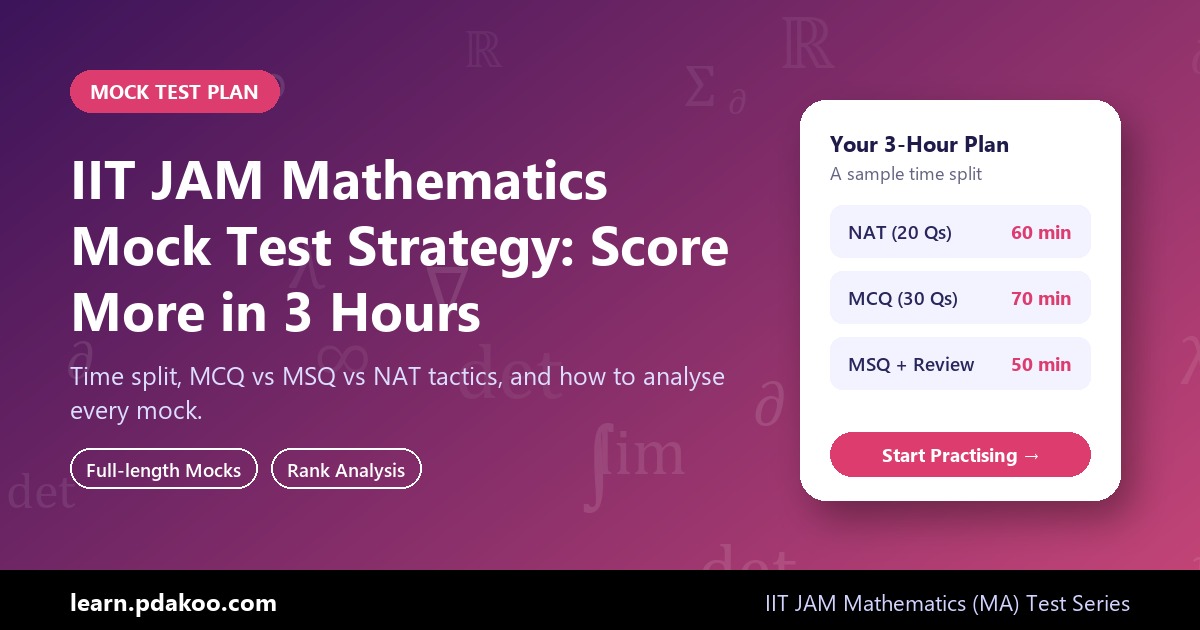
A Sample 3-Hour Plan
There is no single best order, but this split works well for many students. Try it in your mocks and adjust it to your strengths.
1️⃣
First pass: 0–100 min
Go through all sections and solve every question you can do quickly and confidently. Mark the rest for review.
2️⃣
Second pass: 100–160 min
Return to the marked questions, starting with NAT and MSQ (no negative marking), then the MCQs you have narrowed down.
3️⃣
Final check: 160–180 min
Re-check NAT calculations and the number format, and make sure no NAT or MSQ question is left blank by mistake.
Section-wise Tactics
MCQs: guess smart, not blind
With 4 options and a penalty of 1/3, a completely random guess on a 1-mark MCQ has an expected score of ¼ × 1 − ¾ × ⅓ = 0. So blind guessing gains you nothing on average. But if you can eliminate even one option, the expected score turns positive, and guessing becomes worth it.
MSQs: be sure about every option
There is no partial credit, so one wrong tick costs you the whole 2 marks. Check each option independently, as a separate true/false question. Look for a counterexample for every statement that seems true.
NATs: never leave them blank
There is no negative marking, so always enter an answer, even if it is your best estimate. Read the rounding instruction carefully (for example, "rounded off to two decimal places").
💡 Pro tip: Answer the 2-mark NAT questions in Section C carefully. They are worth 20 marks with no risk, and they are often more straightforward calculations than they look.
How to Analyse a Mock Test
The real improvement happens after the test. Use the performance analysis on Pdakoo to sort every lost mark into one of these buckets:
↔ Swipe the table sideways on mobile to see all columns.
| Type of error | What it looks like | How to fix it |
|---|
| Concept gap | You didn't know how to start | Revise the theory and solve that chapter's PYQs again |
| Silly mistake | Right method, wrong calculation or misread question | Slow down on reading; underline key words like NOT and FALSE |
| Time pressure | You knew it but ran out of time | Practise the first-pass/second-pass method; skip faster |
| Bad guess | Negative marks from MCQs you weren't sure about | Guess only after eliminating at least one option |
How Many Mocks Should You Take?
- During preparation: one subject-wise test after every unit.
- Last 2–3 months: one full-length mock per week, then two per week in the final month.
- Last week: one or two mocks only, just to stay in rhythm. Use the rest of the time to revise your mistake log.
Practise This Strategy on Pdakoo
📚
Subject-wise tests
Section-wise practice for Real Analysis, Linear Algebra, Group Theory, Differential Equations and Calculus.
🗂️
Chapter-wise PYQs
Previous year questions arranged chapter by chapter, so you can see exactly how each topic is asked.
⏱️
Full-length mocks
Mock tests in the real JAM format to build speed, accuracy and 3-hour stamina.
📈
Analysis & rank
Performance analysis and rank-based evaluation after every test, with progress tracking.
Test your strategy before the real exam.
Full-length mocks in the actual JAM format with rank and analysis are in the Pdakoo IIT JAM Mathematics Test Series.
Explore the Test Series →
Frequently Asked Questions
Should I attempt all 60 questions in IIT JAM Mathematics?
Attempt all NAT and MSQ questions, since they have no negative marking. Attempt MCQs when you are sure or can eliminate at least one option.
Which section should I attempt first?
Many students start with the section they are most comfortable in. A popular approach is a quick first pass through the whole paper, followed by a second pass on the harder questions.
Is there partial marking in MSQ?
No. You get the full 2 marks only if you select exactly the correct options. There is also no negative marking in MSQ.
How do I improve my speed in JAM Mathematics?
Take timed subject-wise tests, learn standard results and shortcuts, and practise full-length mocks regularly. Analysing each mock shows where your time goes.
Where can I take IIT JAM Mathematics mock tests online?


 Launch your Graphy
